
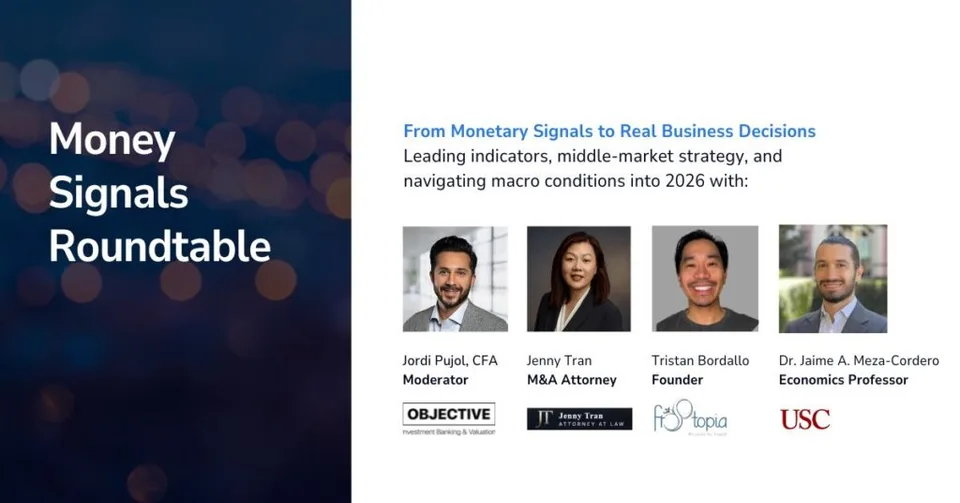

In Objective’s Money Signal Roundtable, a panel of practitioners and experts tackled a question most business owners feel long before it shows up in the headlines: how do tighter monetary conditions actually hit the middle market and what are the earliest warning signs? Moderated by Jordi, the discussion brought together Tristan (Founder & CEO of Fr8topia), Dr. Jaime (economist and professor at USC), and Jenny Tran (founder of Jenny Tran Law, business, M&A and tax counsel for Founder-Led businesses). Their combined message is the economy is stable in aggregate, but the pain and opportunity arrive unevenly across sectors.
The earliest signals don’t come from the Fed they show up in customer behavior
Jordi opened with a practical, operator-level question: Before the data confirms a shift, what changes inside the business tell you monetary conditions are tightening? Tristan’s answer was blunt and immediate: it starts with how customers buy and how customers pay.
On the revenue side, Tristan saw shippers move volume from contracted freight to the spot market. That shift matters because contracted rates offer predictability, while spot rates can collapse quickly when demand softens. When shippers start “testing” spot pricing, it signals they’re prioritizing flexibility and cost, often because their own demand picture is changing. For trucking companies carrying fixed costs (equipment, insurance, maintenance), a spot-driven environment can turn brutal fast.
At the same time, Tristan noticed another early indicator: lower shipping frequency and reduced volume. Demand was softening. Combined with shippers pushing freight to spot, it created a “perfect storm”: lower utilization and collapsing rates exactly the combination that forces hard operating decisions.
Tight money creates double pressure: higher financing costs and weaker cash conversion
Beyond pricing pressure, Tristan described a second squeeze: cash behavior deteriorates. Customers who used to pay in 30 days stretch to 45, then 60, then 90. When receivables slow down while rates are falling, operators are forced to finance working capital. In trucking, one common tool is factoring, which brings faster cash but adds another cost layer.
The operational outcome was not subtle. Tristan explained that tightening conditions forced him to hit the brakes on growth and prioritize liquidity: at peak, his company ran 18 trucks, then downsized to 10, and now operates four. Expansion plans halted. New equipment purchases stopped. Nonessential equipment got sold. Instead of “growth at speed,” the strategy became survival through cash discipline and lane optimization choosing routes and freight that offered better margins instead of running trucks simply to stay busy.
His summary was a lesson many middle-market owners can relate to: when the cycle turns, the goal isn’t to win every deal. It’s to preserve flexibility long enough for conditions to improve.
Why rates rose in 2022 and why they may stay elevated into 2026
To connect the ground-level experience to policy, Jordi asked Dr. Jaime to walk back through the rate environment that shifted dramatically beginning in 2022.
Dr. Jaime framed the Federal Reserve’s role through its dual mandate: (1) maximize employment and (2) keep inflation under control, specifically by maintaining credibility around an inflation target. When inflation runs above target long enough, people begin to assume higher future prices, renegotiate wages, and adjust behavior in ways that can make inflation persistent. From the Fed’s perspective, that credibility risk is existential.
So why did rates rise? Dr. Jaime pointed to the inflation shock following massive stimulus injections, increased demand, supply chain disruptions, and cost pressures. The Fed’s principal tool is raising interest rates, which reduces borrowing and investment, slows aggregate demand, and helps bring inflation down.
The more interesting question for 2026 is why rates haven’t fallen as much as many expected. Dr. Jaime noted that unemployment has remained relatively low (around the “normal” range), and GDP growth has stayed positive, meaning the employment side of the mandate doesn’t require urgent easing. Inflation, however, remained above target, which helps explain why the Fed has been hesitant to cut aggressively. He also emphasized a point business owners often overlook: a federal funds rate around 3.5% may feel high relative to the prior decade, but it gives the Fed room to respond if a recession hits. When rates are near 0–1%, there’s less monetary “ammo,” and governments tend to lean more heavily on fiscal stimulus, adding to long-term debt concerns.
In short, Dr. Jaime’s view suggests a realistic planning baseline for owners: do not build your 2026 operating plan around a rapid return to ultra-low rates.
Capital discipline is back and it’s reshaping deals, hiring, and tax strategy
Jenny Tran brought the discussion into the middle market advisory world. Her observation: the biggest shift she’s seeing is capital discipline. Where low-rate years rewarded speed and leverage, today’s environment is pushing owners to borrow for “accuracy and survival.”
Operationally, she’s seeing clients reduce leveraged expansion, move toward phased growth, and hire more slowly. On the transaction side, she described a major change in deal structures: more financing burden is shifting to sellers. Instead of the old expectation of a heavy cash component up front, sellers are more often seeing higher earnouts, larger seller notes, and more rollover equity. Buyers want downside protection when debt is expensive and cash flow visibility is less certain, so structures become more “creative,” but also more complex and risk-shifted.
From a tax perspective, Jenny highlighted how legislation and depreciation rules can create unusual incentives to buy equipment even when borrowing costs are high. Tristan jumped in with real numbers that made the inflation point tangible: a new truck that might have cost ~$130K in 2018 is now $180K–$220K, and trailers have risen materially as well. The practical takeaway: if owners are going to spend in this environment, they need to balance the true cost of borrowing against cash tax savings, and they need to plan deliberately, not impulsively.
Don’t “freeze” the business: cut fat, not muscle
One of the most important strategic moments came when Jenny warned about a common mistake in downturns: owners overcorrect by cutting everything. She used a simple analogy: when you diet, you want to lose fat—not muscle. For businesses, freezing spend across the board can protect short-term cash flow but harm long-term valuation.
Her example was particularly sharp: a business owner cut bookkeeping spend, which looked like savings in the quarter. But when it came time to sell, weak financial reporting made it difficult for buyers to validate margins and product economics. The buyer assumed worst-case scenarios, which depressed valuation, turning a short-term savings decision into a major value loss at exit. The broader point: buyers don’t just pay for EBITDA, they pay for systems, visibility, and repeatability.
Protective actions: underwrite customers like they underwrite you
When Jordi pressed for “protective actions” that help companies survive cycles, Tristan returned to his strongest signal: collections. In his view, receivables tell the truth about a customer’s health faster than most dashboards. If customers are stretching payments, risk is rising.
His core defensive move: accounts receivable insurance. He shared a story where a major customer went out of business unexpectedly. Because the account was insured, he recovered most of the exposure (even though it took time and didn’t pay 100%). His point was straightforward: “hoping” a customer pays isn’t a strategy. In tight money environments, owners must build protections that assume counterparties can fail.
Jenny expanded that concept to human capital. With unemployment relatively low and recruiting expensive, she’s urging owners to retain key talent through incentive alignment: profit-sharing, equity incentives, or other “share and share alike” structures that don’t necessarily cost cash immediately but tie key employees to long-term outcomes. Jordi reinforced that these programs can turn employees into owners in mindset, an advantage when every dollar matters.
Macro stability doesn’t mean your sector is safe
As the conversation closed, Dr. Jaime made a crucial clarification: macro indicators can show stability while individual businesses face turbulence. Consumption may remain strong overall, but who is buying, what they’re buying, and which sectors are benefiting can shift quickly, especially as technology (including AI) disrupts jobs and reshapes cost structures. His recommendation for owners: plan now, stay opportunistic, and be ready to invest when conditions and demand patterns in your niche become clearer.
The hard-earned lesson: preparation happens before chaos
When asked what owners often learn “the hard way,” both Tristan and Jenny emphasized preparation. Jenny urged owners to take tax structuring seriously years before an exit, not during a deal. Governance choices and entity structure can lock in outcomes that take time to unwind. Tristan echoed the same principle from an operator’s lens: resilience is built before the storm through cash discipline and decisive execution, not during crisis.
What to take into 2026
If there was a single unifying theme from the roundtable, it was this: signals show up first in behavior, customer purchasing behavior, payment behavior, hiring behavior, deal structures, and talent movement. Owners who build systems to notice those shifts early can move before the data confirms what’s already happening on the ground.
2026 may not be a year of dramatic Fed moves. It may be a year of sector-by-sector divergence, where disciplined operators win by underwriting customers, preserving liquidity, investing selectively, and aligning their teams. The goal isn’t to predict every shock. It’s to build a business that can absorb them, and still compound value over time.
More about the Panelists

Jenny Tran
Business, Mergers & Acquisitions, and Tax Counsel
Jenny Tran is a business, M&A, and tax attorney advising founder-led businesses and owner-operators. Coming from an entrepreneurial family, she brings a practical, business-minded perspective to legal and tax strategy, with a focus on clarity, alignment among advisors, and outcomes that work both on paper and in practice.

Tristan Bordallo
Founder & CEO, Fr8topia | Venture Partner & Advisor
Tristan Bordallo is a three-time founder and entrepreneur with over 20 years of experience in the trucking and freight industry. As Founder and CEO of Fr8topia, he leads an asset-based, driver-first trucking company operating nationwide. Tristan also serves as a venture partner and advisor to supply chain and consumer brands, bringing an operator’s perspective to building resilient, people-centered businesses.

Dr. Jaime A. Meza-Cordero
Associate Professor of Economics, USC
Dr. Jaime Meza–Cordero is an Associate Professor of the Practice of Economics at the University of Southern California, specializing in international macroeconomics, development economics, and public policy. His work focuses on labor markets, human capital, and evidence-based policy design, drawing on extensive experience in applied research for governments and international organizations.
About the Moderator

Jordi Pujol, CFA
Managing Director, Objective’s Valuation Advisory Group
Jordi Pujol is a Managing Director at Objective Investment Banking & Valuation, where he leads the firm’s Valuation Advisory Group. He oversees valuation services across financial reporting, tax, transactions, and strategic advisory matters, while driving national expansion and partnerships with financial and transaction advisors. Prior to Objective, Jordi was a Senior Manager at EY in Strategy and Transactions, focusing on technology and healthcare valuations. He has over 15 years of financial modeling and valuation experience and is a recipient of The M&A Advisor’s Emerging Leaders Award. Jordi holds degrees from Swarthmore College, EGADE Business School, and The Wharton School, and is a CFA charter holder.
https://www.objectiveibv.com
Disclosure
This news release is for informational purposes only and does not constitute an offer, invitation or recommendation to buy, sell, subscribe for or issue any securities. While the information provided herein is believed to be accurate and reliable, Objective Capital Partners and BA Securities, LLC make no representations or warranties, expressed or implied, as to the accuracy or completeness of such information. All information contained herein is preliminary, limited and subject to completion, correction or amendment. It should not be construed as investment, legal, or tax advice and may not be reproduced or distributed to any person. Securities and investment banking services are offered through BA Securities, LLC Member FINRA, SIPC. Principals of Objective Capital are Registered Representatives of BA Securities. Objective Capital Partners and BA Securities are separate and unaffiliated entities.